
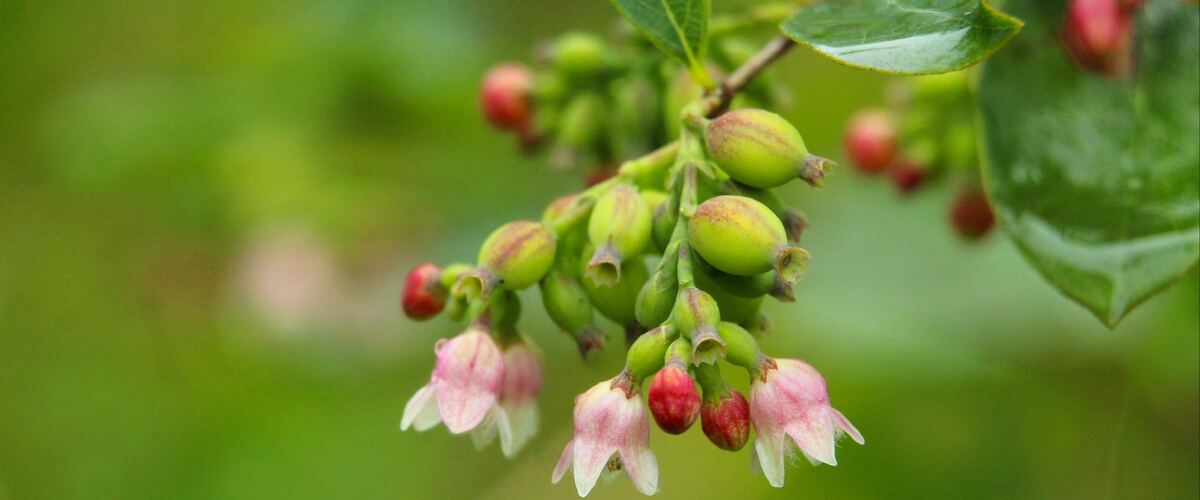
Oregon · Washington · Idaho
When to plant huckleberries
Plant in the garden: Portland and Seattle Mar 1 – Apr 26; Spokane Apr 1 – May 27; Boise Mar 20 – May 15; Bend Apr 28 – Jun 23.
Your dates in
Huckleberries are blueberry relatives with small, dark berries that taste like a sharper, wilder blueberry, eaten fresh or baked into pies, jam and pancakes. The garden plant on this page is evergreen huckleberry, a native shrub also grown as a glossy hedge for shade, and its cut branches are a long-standing florist green. Idaho named the huckleberry its state fruit, but that is the mountain species picked wild in the high country.
Puts huckleberries on your free plan, with dates for your town and a spot in your beds.
- Difficulty
- Moderate
- Sun
- Part shade to full sun
- Spacing
- 3 to 5 feet apart
- Planting depth
- Same depth as in the pot
- Frost
- Hardy perennial; comes back every year
- First harvest
- Light crops after two to three years; plants are slow to start
Evergreen huckleberry is the native that grows well in gardens west of the Cascades, with glossy leaves and sweet-tart berries in late summer and fall. Mountain huckleberries, the ones people pick in the Cascades, rarely do well at low elevation.
Huckleberry planting dates
| Towns | Plant in the garden |
|---|---|
| Portland, OR, Seattle and Tacoma, WA | Mar 1 – Apr 26 |
| Spokane, WA | Apr 1 – May 27 |
| Boise and Meridian, ID | Mar 20 – May 15 |
| Bend and Redmond, OR | Apr 28 – Jun 23 |
| Astoria, OR | Mar 25 – May 20 |
Dates for six main cities. For any of the other 80 towns, type it in the box at the top of the page or browse all towns.
| Gresham, OR, Oregon City and West Linn, OR, Portland, OR, St. Helens and Scappoose, OR, Wilsonville and Canby, OR | Mar 1 – Apr 26 |
|---|---|
| Hillsboro and Beaverton, OR | Mar 5 – Apr 30 |
| Corvallis and Albany, OR, Eugene, OR, Salem, OR | Mar 1 – Apr 26 |
|---|---|
| Cottage Grove, OR | Mar 13 – May 8 |
| McMinnville and Newberg, OR | Mar 4 – Apr 29 |
| Ashland and Talent, OR | Mar 25 – May 20 |
|---|---|
| Grants Pass, OR, Medford, OR, Roseburg, OR | Mar 1 – Apr 26 |
| Astoria, OR, Brookings and Gold Beach, OR, Coos Bay and North Bend, OR, Newport and Lincoln City, OR, Tillamook, OR | Mar 25 – May 20 |
|---|
| Bend and Redmond, OR, Klamath Falls, OR | Apr 28 – Jun 23 |
|---|---|
| Burns, OR | Apr 30 – Jun 25 |
| Lakeview, OR | Apr 23 – Jun 18 |
| Madras, OR, Prineville, OR | Apr 20 – Jun 15 |
| Baker City, OR, Enterprise and Joseph, OR, John Day, OR | Apr 20 – Jun 15 |
|---|---|
| Hermiston, OR, Hood River, OR, Ontario, OR, Pendleton, OR, The Dalles, OR | Mar 20 – May 15 |
| La Grande, OR | Apr 1 – May 27 |
| Bremerton and Port Orchard, WA, Everett, WA, Kent, Renton and Auburn, WA, Seattle and Tacoma, WA | Mar 1 – Apr 26 |
|---|---|
| Olympia, WA | Mar 18 – May 13 |
| Shelton, WA | Mar 16 – May 11 |
| Anacortes, WA, Bellingham, WA, Friday Harbor and the San Juans, WA, Mount Vernon and Burlington, WA, Oak Harbor and Whidbey Island, WA | Mar 1 – Apr 26 |
|---|
| Aberdeen and Hoquiam, WA, Forks, WA, Long Beach and Ilwaco, WA | Mar 25 – May 20 |
|---|---|
| Port Angeles, WA, Port Townsend, WA | Mar 1 – Apr 26 |
| Sequim, WA | Mar 10 – May 5 |
| Centralia and Chehalis, WA | Mar 11 – May 6 |
|---|---|
| Longview and Kelso, WA, Vancouver, WA | Mar 1 – Apr 26 |
| Chelan, WA, Wenatchee, WA | Mar 20 – May 15 |
|---|---|
| Leavenworth, WA, Omak and Okanogan, WA | Apr 1 – May 27 |
| Winthrop and Twisp, WA | Apr 3 – May 29 |
| Ellensburg, WA | Apr 1 – May 27 |
|---|---|
| Ephrata and Quincy, WA, Moses Lake, WA, Sunnyside, Grandview and Prosser, WA, Tri-Cities (Pasco, Kennewick, Richland), WA, Walla Walla, WA | Mar 20 – May 15 |
| Goldendale, WA | Apr 7 – Jun 2 |
| Yakima, WA | Mar 27 – May 22 |
| Colville, WA, Pullman, WA, Spokane, WA | Apr 1 – May 27 |
|---|
| Bonners Ferry, ID, Coeur d'Alene and Post Falls, ID, Sandpoint, ID | Apr 1 – May 27 |
|---|
| Lewiston, ID | Mar 20 – May 15 |
|---|---|
| Moscow, ID | Apr 1 – May 27 |
| Boise and Meridian, ID, Emmett, ID, Nampa and Caldwell, ID | Mar 20 – May 15 |
|---|---|
| McCall, ID | May 11 – Jul 6 |
| Burley and Rupert, ID, Idaho Falls, ID, Pocatello, ID, Rexburg, ID, Twin Falls, ID | Apr 1 – May 27 |
|---|---|
| Salmon, ID | Apr 20 – Jun 15 |
Huckleberry year at a glance
| Task | J | F | M | A | M | J | J | A | S | O | N | D |
|---|---|---|---|---|---|---|---|---|---|---|---|---|
| Plant | Mar | Apr | ||||||||||
| Harvest | Aug | Sep | Oct | |||||||||
| In bloom | Apr | May |
Around Portland. Colder towns, especially east of the Cascades, run a few weeks later; the table above has your town's planting dates. Harvest months are for an established plant.
How to grow huckleberries
- Pick a sunny spot with soil that drains well, and mix in an inch or two of compost.
- Plant evergreen huckleberry shrubs on your city's dates, 3 to 5 feet apart. Same depth as in the pot.
- Mulch with bark or fir needles, water through the first two dry seasons, and feed lightly with a fertilizer for acid-loving plants. No pruning needed beyond shaping.
- Harvest: Pick evergreen huckleberries from late August into fall, when they're fully dark and come off easily. They hang on the shrub for weeks.
Growing huckleberries in your part of the Northwest
The same plant behaves differently on the wet west side, the foggy coast and the dry, colder east side.
West-side valleys
Willamette Valley, Puget Sound, southern Oregon
Evergreen huckleberry is native to the west side and coast and grows well in gardens.
Coast
Oregon and Washington coast
Evergreen huckleberry thrives in coastal soils and shade.
East of the Cascades
Columbia Basin, Yakima, Boise, Spokane, north Idaho
Mountain huckleberries grow wild in east-side and Idaho mountains but are notoriously hard to grow in gardens. They need acidic, well-drained soil and rarely fruit much outside the forest.
More huckleberry varieties
More widely sold picks that do well somewhere in the Northwest. The tag says which part of the Northwest suits each one best.
Evergreen huckleberry
Vaccinium ovatum has glossy evergreen leaves and small, sweet black berries that hang for weeks. It is a handsome, shade-tolerant hedge or understory shrub for acidic soil.
Coast and west side
Red huckleberry
Vaccinium parvifolium bears tart, bright red berries on airy green stems. In the wild it often grows on old stumps and logs; it likes shade and rich, woody soil.
Coast and west side
Thunderbird
A compact selection of evergreen huckleberry with tidy growth and attractive foliage. A good size for small gardens, foundation plantings and large containers.
Coast and west side
Mountain huckleberry
Vaccinium membranaceum is the prized wild huckleberry of the Cascades, with large, sweet purple berries. It is slow and tricky in gardens and does best in cool, high-elevation sites.
Short seasons
How much to grow
How many to plant
Plant 3 to 5, about 3 to 5 feet apart, for an informal hedge or a woodland edge. Evergreen huckleberry grows slowly to 4 to 8 feet.
What to expect
A mature evergreen huckleberry gives a few quarts of berries over a long season.
Storing the harvest
Keep about a week in the fridge. Freeze on a tray, or make jam.
Key numbers
- 4.5–5.5 (acidic)Soil pH
- 2–3 yearsFirst light crop
- Late August into fallHarvest
- Heavy or alkaline soilBiggest risk
Top care tip: Keep a layer of bark or fir needle mulch on top to hold moisture and keep the soil acidic.
Growing notes
What makes the difference in Northwest gardens, in plain language.
Which huckleberry to grow
Evergreen huckleberry is the native that thrives in gardens west of the Cascades. It's a handsome shrub with glossy leaves, pink bell-shaped flowers in spring and small, dark, sweet-tart berries from late August into fall. Thunderbird is a compact selection for smaller spaces.
Red huckleberry grows wild in shady forests, often sprouting from old stumps and logs, and has bright red, tart berries in summer. The mountain huckleberries people pick in the Cascades grow at higher elevations and rarely do well in lowland gardens.
Planting like a forest floor
Huckleberries are relatives of blueberries and want the same conditions: acidic, well-drained soil full of organic matter. In the wild they grow in loose, needle-covered soil under conifers. Mix bark fines or compost into the planting area, and mulch with bark or fir needles to keep roots cool and moist.
They're slow to establish, so be patient. Water through the first two dry seasons, and feed lightly with fertilizer for acid-loving plants in spring. Heavy clay or alkaline soil is the main reason they stall.
Wildlife value
Evergreen huckleberry is a favorite with birds, which eat the berries well into winter, and the spring flowers feed native bees and hummingbirds. Its year-round foliage gives cover for small birds. It works well as an informal hedge or under tall trees in light shade, and it needs almost no pruning beyond the occasional shaping. If you share the berries, plant a few shrubs so there's enough for both you and the birds.
Good neighbors
Grows well with
- Salal and sword fern. The same acidic, shady woodland soil under conifers.
- Blueberries. Close relatives with the same acidic, moist soil needs.
Pests and problems
What most often goes wrong with huckleberries in Northwest gardens, how to spot it and what to do.
Slow growth or yellow leaves
Signs: Plants barely grow, or leaves pale between the veins.
What to do: Acidic, well-drained soil rich in organic matter. Mulch with fir needles or bark, not lime-rich compost.
Birds
Signs: Berries disappear as they ripen.
What to do: Plant extra, or net a shrub you want to pick.
Drought in the first summers
Signs: Leaves brown and drop.
What to do: Water deeply every week or two through the first two summers.
Common questions about growing huckleberries
When should I plant huckleberries in Oregon, Washington and Idaho?
Plant in the garden: Mar 1 – Apr 26 in Portland and Seattle, Apr 1 – May 27 in Spokane, Mar 20 – May 15 in Boise and Apr 28 – Jun 23 in Bend. Pick your town at the top of the page for your own dates.
Can you grow huckleberries in your yard?
Yes, especially evergreen huckleberry west of the Cascades. Give it acidic, well-drained soil rich in organic matter, part shade to sun, and water for the first two summers. Mountain huckleberries are much harder to grow at low elevation.
Are huckleberries the same as blueberries?
They're close relatives in the same plant family and like the same acidic soil. Huckleberries are usually smaller and more intensely flavored.
When are evergreen huckleberries ripe?
From late August into fall, when the berries are fully dark and come off easily. They hang on the shrub for weeks, so you can pick a little at a time.
See what else to plant in March or April.
 Oregon grape
 Red-flowering currant
 Serviceberry
 Camas
 Thimbleberry
 Salmonberry
 Salal
 Kinnikinnick
 Western columbine
 Douglas aster
 Oregon sunshine
 Pacific ninebark
 Sword fern
 Oregon iris